Why are we doing this?
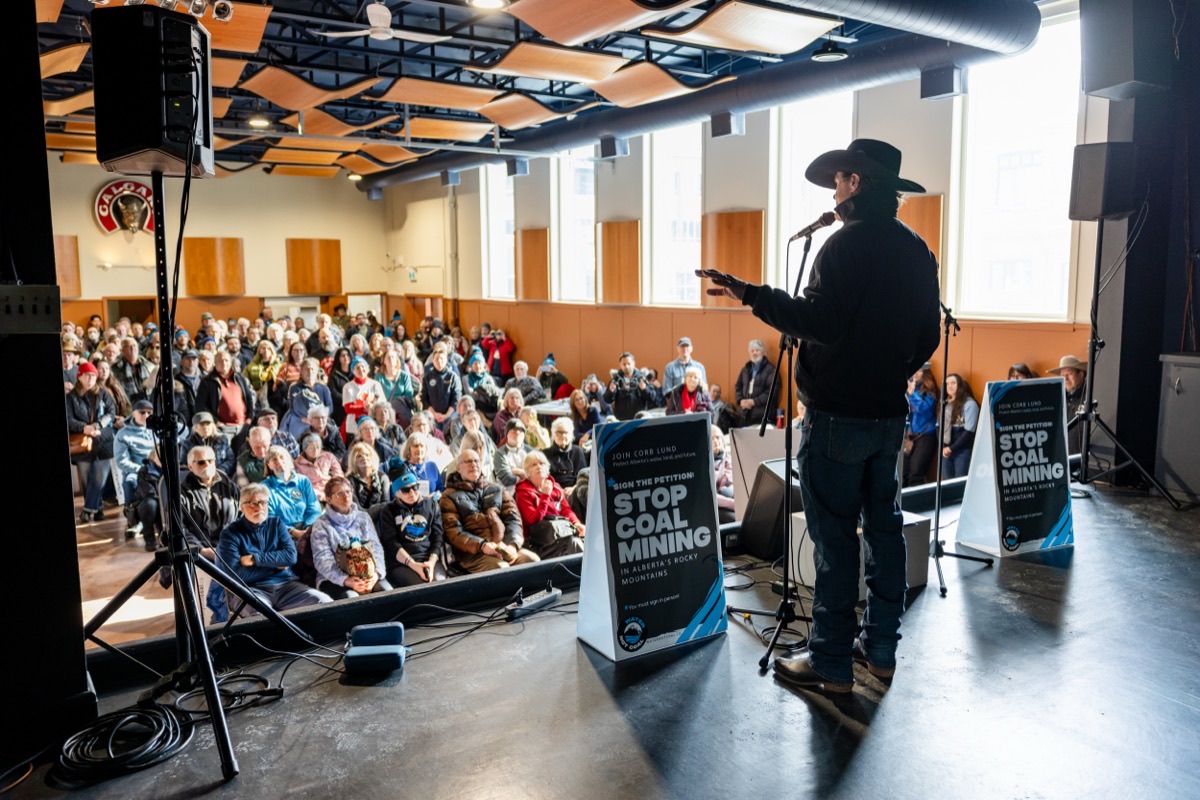
Coal mining in Alberta's Rockies threatens our water.
Coal mines destroy the landscape, and release toxic chemicals into the air and water, which threatens fish, birds, wildlife, livestock and the water we drink. Coal development will also threaten other industries economically such as agriculture, food processing and tourism.
This is why I started a Citizen Initiative Petition to put an end to all new coal mining in Alberta's Rocky Mountains.
— Corb Lund, proud Albertan
These are lengthy answers to many questions. For shorter answers to more common questions, please visit waternotcoal.ca/faq.
The last six years of helping to defend our water and mountains has been quite an education. I know much, much more about coal mining than I did when I started working on this issue. More than I ever wanted to know. But it's a constant and ongoing learning process, and if you find anything in the following information you feel is factually incorrect, please email info@waternotcoal.ca to let us know. I'll research it and if I find I've made a mistake I'll correct it. Please provide supporting materials if possible. I'm happy to fix errors and clarify the material if necessary but I'm confident this material is sourced and accurate.
Why are you doing this and what is this campaign about?
The campaign is focused specifically on prohibiting new coal mining in the Eastern Slopes of Alberta's Rockies, nothing else. These are very important areas that Albertans treasure, containing the headwaters that provide most of the drinking water for the province. Coal mining is notorious for contaminating surrounding groundwater and rivers with a number of toxic pollutants, most notably selenium which is very harmful to fish populations as well as to animals and humans as concentration builds up and bio-accumulates. There is no known economically practical or proven scalable method of preventing this kind of pollution which is associated with coal mines or to clean up the water after it's been contaminated. Contamination builds and bioaccumulates in plants and animals and will be here in our groundwater for decades and possibly centuries after the foreign companies have taken the coal and left. Pollution is not the only disruption that coal mining causes. It tears up landscapes, uses immense amounts of water from streams and rivers for coal processing, and prevents public access to public lands surrounding mine sites.
Who are you, Corb, and why are you involved?
I'm a sixth-generation rural Albertan. Both sides of my family have been involved in agriculture in the province for over 120 years. I spent a lot of my youth horseback on the family ranch near Cardston and I feel very strongly these areas should be protected, especially the water. My grandfather and I rode every inch of that place many times, and every single day he'd comment on the level of the creek and the quality of the water, as well as taking immense pride in the health of his soil and of his grass. I learned at a very young age that water and soil quality are core values for maintaining ecosystems in these types of areas. I currently live in Lethbridge, downstream from the proposed Grassy Mountain coal mining project in the headwaters of the Oldman River. The Oldman provides the drinking water for over 200,000 Albertans, including Lethbridge and many other communities. It also provides irrigation water for farmers and water to a multi-billion dollar food processing industry in Lethbridge. I drink this water myself, as do my friends and my family. Keeping the water clean and the mountains intact is very personal for me. The Rockies are close to my heart and I feel very strongly about not allowing foreign coal companies to destroy them.
Why are these mines a problem? Do they actually contaminate water?
Yes, primarily because they threaten our water with selenium contamination. To get at the coal seams, they remove the soil and rock off of the mountain, crush it into smaller rock and dump it somewhere close by. Rainwater washes over those freshly exposed broken rock surfaces and leaches selenium into groundwater. Teck Resources, one of the largest and most advanced mining companies in the world, has [spent over a billion dollars trying to fix this](https://www.cbc.ca/news/canada/british-columbia/selenium-teck-coal-mine-toxic-pollution-1.7149181) in BC's Elk Valley area and can't. [Fernie and Sparwood have had to stop using some of the sources of their municipal water](https://thenarwhal.ca/bc-fernie-drinking-water-selenium/) due to selenium contamination. [Montana groups are suing](https://earthjustice.org/press/2023/conservation-groups-go-to-court-alongside-montana-deq-to-protect-montana-and-idaho-waters-from-canadian-coal-mine-pollution) [the government of British Columbia](https://earthjustice.org/press/2023/conservation-groups-go-to-court-alongside-montana-deq-to-protect-montana-and-idaho-waters-from-canadian-coal-mine-pollution), to try to protect their rivers and lakes from coal mining pollution. [Contamination](https://pubs.acs.org/doi/10.1021/acs.est.3c05090) from the Elk Valley has reached [hundreds of kilometers](https://pubs.acs.org/doi/pdf/10.1021/acs.estlett.4c00222) downstream [and has polluted the Kootenay River and Lake Koocanusa in the US.](https://e360.yale.edu/features/from-canadian-coal-mines-toxic-pollution-that-knows-no-borders) [Here in Alberta, rivers downstream of closed mines (Gregg River, Luscar, Cheviot) on the McLeod river still have high selenium levels decades after closing.](https://www.cbc.ca/news/canada/edmonton/selenium-alberta-coal-mines-contamination-1.5886293) Selenium is not the only issue, other contaminants have been [found to be 200 times higher in concentration downsteam from the mines than upstream](https://www.cbc.ca/news/canada/edmonton/alta-coal-mines-1.7599449). Even older historic mines in southern Alberta (Tent Mountain and Grassy) [that have certificates of reclamation continue to contaminate](https://www.cbc.ca/news/canada/calgary/contamination-from-old-coal-mines-in-alberta-s-rockies-raises-cleanup-questions-1.7099909) our mountain rivers. Government of Alberta data has show [contamination levels downstream from existing coal mines near Hinton, Alberta are four to nine times the provincial guidelines for what is safe](https://www.cbc.ca/news/canada/edmonton/selenium-alberta-coal-mines-contamination-1.5886293), and former Alberta Environment scientists have raised concerns that found [the government suppressed this data for 10-15 years](https://thenarwhal.ca/alberta-stalled-coal-mine-pollution-study/). [Current government studies show that the Grassy Mountain area is already high in selenium from legacy mining.](https://thetyee.ca/News/2025/06/02/Coal-Mines-Crowsnest-Pass-Killing-Fish/#:~:text=After%20a%202024%20government%20study,communities%20downstream%20of%20coal%20mining.) Dr. Colin Cooke, a government of Alberta scientist who has conducted a number of damning studies on coal related air and [water contamination](https://www.sciencedirect.com/science/article/pii/S0269749124000423) has not been given permission to speak with the public or the media, despite requests from nearly every major outlet. Minister Schulz's office [responded to questions about this](https://thetyee.ca/News/2025/06/02/Coal-Mines-Crowsnest-Pass-Killing-Fish) by saying Dr. Cooke is "a trained researcher, not a trained spokesperson." This is infuriating because what the Premier is actually saying is that 'Dr Cooke will just tell you the truth about his studies, instead of distorting it to fit our narrative, since he's not a 'trained spokesperson' like us.' Dr. Cooke's studies showed [extremely high levels of selenium in the trout in Crowsnest Lake](https://www.cbc.ca/news/canada/calgary/coal-eastern-slopes-study-1.7554726), to the extent that [the government had to issue a fish consumption advisory for Crowsnest Lake](https://mywildalberta.ca/fishing/advisories-corrections-closures/fish-consumption-advisory.aspx), telling the public to limit consumption of trout and whitefish due to selenium contamination. Prominent animal nutritionist [Lee Eddy states](https://registrydocumentsprd.blob.core.windows.net/commentsblob/project-81436/comment-56362/Lee%20Eddy%20paper%20on%20selenium.pdf) "From a purely academic point, Southern Alberta would be the only location in the world to have the top three causes of man-made selenium contamination of water in the same river system." Any amount of selenium leaching into the Oldman watershed via Grassy Mountain would be especially harmful because selenium would bioaccumulate downstream in an already stressed river Why on earth would we add to an already overburdened area? The technology to prevent selenium contamination doesn't exist in any practical form. The coal companies and the government are asking us to trust them and their track record is abysmal - they've repeatedly failed to follow through on their commitments. The risk to Alberta's water supply is just too high to take any kind of gamble trusting these people with it. The mining companies like to say misleading things like "selenium is naturally occurring", and while that may be true, concentrating it the way coal mining does is not natural or healthy for aquatic life or humans. For example, we need oxygen to live also, but too much of it becomes very toxic. It's all a matter of the amount. All types of mining are bad for our water sources. Claims that underground mining is "safer for water" aren't supported by hydrogeology or real‑world experience. Underground mines disrupt groundwater, increase water‑rock contact (which results in water contamination), and require extensive dewatering and stream diversion, changes that are rarely reversible. There are poor financial penalties for contaminating the water, and the clean up costs are going to be left to the taxpayers. [CST Coal's underground mine near Grande Cache spilled over 1 million litres of contaminated mine waste water into the Smoky River, which was only one of several spills in 2023 alone. They were fined $9,000 for this environmental infraction.](https://www.cbc.ca/news/canada/edmonton/alberta-coal-river-leak-fine-1.7470360) [The coal companies aren't required to post adequate cash bonds anywhere close to levels required to actually do the cleanup after mining is shut down.](https://ablawg.ca/2025/03/19/beyond-the-pale-the-february-2025-updates-to-the-mine-financial-security-program/) Albertans are already in an enormous reclamation deficit for abandoned oil wells, coal mining will just compound the clean up costs while wealthy investors get rich.
What about air quality and the visual impact?
Coal mining creates massive amounts of particulate matter - dust and debris that spreads far beyond the mine site. People downwind breathe that and it settles in nearby lakes and contaminates the water and the fish. Mountains will be permanently scarred. You'll see it from highways, from ski hills. That damages our tourism economy - skiing, fly fishing, hiking. Those are sustainable jobs. Dr. Cooke has conducted [studies addressing airborne contaminants blown over the Rockies from the mines in BC](https://pubs.acs.org/doi/10.1021/acs.estlett.2c00677) and found significantly increased concentrations of selenium and extremely elevated levels of coal-derived contaminants in area lakes. Opening coal mines in the extremely windy areas of [southwestern Alberta](https://pubs.acs.org/doi/10.1021/acs.est.4c02596?ref=recommended) could result in [coal related contaminants blowing east into Calgary and Lethbridge](https://www.cbc.ca/news/canada/calgary/coal-study-mountaintop-contamination-lake-alberta-1.6639875) as well as poisoning high-mountain lakes in the Kananaskis.
Why is there such emphasis on the Grassy Mountain Project in the petition?
Because Grassy Mountain is one of the imminently looming projects in an extremely sensitive area at the headwaters of the Oldman River that provides drinking water for 200,000 people and is the thin edge of the wedge for a larger plan to allow much more coal mining [in a much larger area of our Rocky Mountains.](https://cpawsnab.org/wp-content/uploads/2026/03/EasternSlopes_ss_full.png) The project has already been [deemed to be not in the public interest by the federal government](https://www.cbc.ca/news/canada/calgary/federal-government-grassy-mountain-jonathan-wilkinson-1.6132883), the provincial Alberta Energy Regulator and the provincial courts of appeal but the project is being allowed to reapply for a full mining license very soon. It is a 'foot in the door' as it will reportedly provide much of the loading infrastructure for future mining projects. Grassy is the thin edge of the wedge and if we don't stop Grassy Mountain, more and more mines will follow. Grassy is the goal line stand.
Have mining practices actually changed enough to reduce the risks
Reclamation cannot put the mountain back, it is misleading for mining companies to say they will reclaim as if that fixes everything. You can plant grass seed on the hill after the mine closes but anyone can understand that you can't recreate a complex mountain ecosystem that evolved over millions of years. While wastewater mitigation measures have improved, they are still not effective enough to contain pollution levels below what is safe for aquatic life. Additionally, new technologies have not been proved at the scale of an operating mine, particularly in such complex hydrogeology as the Rocky Mountains. Coal companies have not shown if or where new technology has actually been successful. Some have argued that, because there is a part of Grassy Mountain that was historically mined, that a new mine project will also clean up the old mining remains. The footprint of the new project is going to be many times larger than the existing area that needs to be cleaned up. It would make much more economic sense for the government to just pay to clean up the existing Grassy site instead of allowing a much bigger mine to make a much bigger mess that taxpayers will eventually have to pay much, much more for in the future.
But what about jobs?
Obviously jobs are important. But just saying the word 'jobs' doesn't mitigate all the negatives of a project. In 2021, the University of Calgary School of Public Policy conducted a [comprehensive cost-benefit analysis](https://www.policyschool.ca/wp-content/uploads/2021/11/EFL53_Coal-Mining_Winter-et-al.pdf) on the coal mining in the Eastern Slopes of Alberta. While the study acknowledges a relatively small benefit for workers in the short-term, it concluded that coal mine development is not likely to be a net benefit to Alberta, and the costs outweigh the benefits. This conclusion was based on uncertain benefits compared to the displacement of other economic activity (primarily ranching and tourism), reclamation liabilities, and negative social impacts on nearby communities. Job Uncertainty Coal company messaging claims a few hundred jobs will be created at Grassy Mountain. However, the economic benefits of coal mining are often overstated. A [study on three coal mines in British Columbia](https://www.sciencedirect.com/science/article/abs/pii/S0195925523000409?via%3Dihub) found that only 59% of forecasted jobs and 34% of forecasted tax revenue occurred over the lifespan of the mines. This is in part due to the boom and bust nature of the coal industry and the vague nature of proponents' promises. The number of permanent local jobs will likely only decrease as automation takes over. [The mining industry is embracing automation at a rapid pace](https://www.cbc.ca/news/canada/calgary/mining-companies-betting-on-autonomous-technology-to-make-dangerous-jobs-safer-1.6888075). Valory Resources, which owns the Blackstone project and Mine 14, has talked about the benefit of how they don't have to treat Alberta workers the same way they would have to treat Australian ones. For one person in a Canadian coal mine you need four in an Australian one. This is because of Australia's labour laws, union requirements, different work practices, and higher penalty rates. Displacement of Other Economies Proposed coal exploration and mining in the region introduces significant risks to long-term economic activities, including ranching, agriculture, recreation, and tourism all of which depend on healthy landscapes and reliable water resources. Ranching would be impacted both by direct loss of grazing leases that overlap with the mine development as well as [impacts on water quantity and quality](https://cpaws-southernalberta.org/wp-content/uploads/2025/03/Air-Quality-and-Health-Risk-Study_-Proposed-Coal-Mine-Development-Final-for-Submisssion-to-the-CPC-20210914.pdf) given their dependence on water resources, creating higher costs of production or even limiting it altogether. Agriculture downstream faces similar risks, as mines would increase sedimentation, consume significant water in an already stressed basin, and [contribute to selenium and other contamination](https://www.wsga.ca/pdf/2021/ARTICLE-coal-selenium-and-the-watershed.pdf), raising production costs, especially during worsening droughts. For example [McCain just expanded a Lethbridge plant which will create 260 perpetual jobs](https://www.cbc.ca/news/canada/calgary/mccain-potato-processing-french-fry-alberta-expansion-1.6777317). Ross McKenzie P.Ag., PhD. has raised concerns that the [Grassy Mountain Project could put downstream agriculture in jeopardy](https://www.grainews.ca/columns/selenium-sits-on-thinnest-line-between-health-and-hazard/). It makes no economic sense to put thousands of existing sustainable jobs in the agriculture and food processing industries at risk. Recreation and tourism, emerging economic drivers in the region and Alberta aims to grow its visitor economy to [$25 billion in annual spending by 2035](https://open.alberta.ca/publications/higher-ground-tourism-sector-strategy). The Eastern Slopes are a foundational component to the provincial tourism sector and would also be harmed as full mine development would degrade water resources, diminish sport fishing, decrease air quality, increase coal dust, and damage scenic landscapes, reducing the area's appeal to visitors. Overall, while coal mines offer modest jobs, these are outweighed by significant negative impacts on ranching, agriculture, and tourism. Meanwhile, there are 200,000+ people downstream of the Grassy Mountain mine project who depend on this water, plus a multi-billion dollar food processing industry in Lethbridge.
What About Reclamation and Long-Term Liabilities
The most relevant thing for fiscal conservatives is the clean up cost. For years now we have been saying that if these mines open up, somewhere down the line when the coal is no longer profitable, the companies will go home, restructure, go bankrupt, etc, and leave a massive clean up bill for the taxpayer. Unfunded mine liabilities in Alberta have become a major concern. The province's Mine Financial Security Program (MFSP) manages coal and oil sands liabilities by collecting financial security from coal and oilsands mine owners. However, the program is repeatedly criticized for collecting only a fraction of the security needed to cover actual closure and reclamation costs because it relies on future profits to fund future cleanup. [Alberta's 2025 Auditor General](https://www.oag.ab.ca/wp-content/uploads/2025/12/2025-Mine-Financial-Security-Program-AOI.pdf) Report highlights that the government holds just $1.8 billion in security against an estimated $51.9 billion in oilsands mine liabilities, leaving taxpayers exposed if companies walk away or become insolvent. [Legal experts](https://ablawg.ca/2025/10/03/the-2025-mine-financial-security-program-update-security-collected-for-aging-syncrude-mine-offers-a-first-estimate-of-mine-closure-costs/) have similarly described the MFSP as not achieving its purpose noting that it allows companies to delay posting full security until late in a mine's life, creating risk that liabilities will continue to outpace reclamation security deposits. This same mechanism would manage liabilities for new coal mines. A similar pattern has been seen with orphan‑wells in Alberta. Decades of lax liability management allowed companies to defer reclamation until the end of a well's life, only for many operators to collapse or offload aging assets to under‑capitalized firms. In some cases, it is the same investors who walked away from oil well clean-ups pivoting to investing in mining. W. Brett Wilson, previously the majority investor of Forent and oil and gas company, declared the company bankrupt before paying clean up dues to the AER, or owed taxes to Municipalities. W. Brett Wilson is now a major investor in Valory Resources, the company that owns Blackstone and Mine 14. Globally, coal companies have a long pattern of abandoning mines or declaring bankruptcy to offload cleanup obligations, leaving governments and communities to absorb the costs. In British Columbia, [Quinsam Coal Corporation](https://www.lexology.com/library/detail.aspx?g=db469f01-10f9-4c5c-8d84-63d7bef2a031) entered bankruptcy in 2019, and the court‑appointed trustee formally abandoned the mine site without fulfilling closure, reclamation, or remediation obligations, leaving the province responsible for environmental risks. In the United States, a wave of major coal bankruptcies used bankruptcy and insolvency proceedings to offload hundreds of millions of dollars in mine‑reclamation liabilities (see [here](https://review.law.stanford.edu/wp-content/uploads/sites/3/2019/04/Macey-Salovaara-71-Stan.-L.-Rev.-879.pdf), [here](https://appvoices.org/2025/02/18/south-fork-coal-company-bankruptcy-filing/), and [here](https://www.moneylife.in/article/how-bankruptcy-helps-the-coal-industry-avoid-environmental-liability/70587.html)). Australian coal companies operating in Alberta have set up similar limited liability single-purpose companies which could leave taxpayers with the massive clean up cost. Similar dynamics have played out in Australia, where [Linc Energy collapsed in 2016](https://www.qld.gov.au/environment/land/management/abandoned-mines/remediation-projects/hopeland), leaving behind a contaminated underground coal‑gasification site that required government intervention. When coal markets decline, companies often lack the financial capacity, or incentive, to complete mine cleanup, leaving governments and communities to absorb long‑term environmental costs.
What about the royalty revenue for Alberta?
Alberta's coal royalty regime is far more generous on the front end to mining companies than major competing jurisdictions. [Alberta starts at 1%](https://www.alberta.ca/coal-royalties-and-reporting), while [New South Wales charges roughly 9% to 11%](https://www.revenue.nsw.gov.au/taxes-duties-levies-royalties/royalties/coal) and [Queensland starts at 7% and climbs much higher when prices rise](https://www.legislation.qld.gov.au/view/pdf/asmade/sl-2025-0108). When the government changed the coal policy, they gave these companies [a sweetheart deal - much lower royalties than in Australia](https://www.alberta.ca/coal-royalties-and-reporting). That's why a Australian billionaires set up shop here. It's not going to leave Albertans much money, and we'll be stuck with the cleanup costs after they leave. This is a key part of this whole situation. When it's no longer profitable to mine our coal, they'll leave and we'll still be here. Frankly, whatever the royalty rate, It is not worth ruining our water and mountains over. You can't drink money. The insultingly low royalty rate is just one more reason these mines are a terrible idea.
Didn't the government fix this?
No, they absolutely have not. They've been saying it's 'fixed' for six years now, while finding new loopholes. In 2021 they claimed they restored protections. In 2022 they created "advanced project" exemptions. In 2024 new rules supposedly banned mines but exempted Grassy Mountain and Mine 14 and Blackstone, and, and and, etc. They even [changed petition rules retroactively](https://www.cbc.ca/news/canada/edmonton/alberta-legislation-would-change-citizen-referendum-rules-restrict-political-party-names-9.7003718) after approving ours. Albertan's have been saying no to new coal mines for years now. (See timelines [here](https://cpawsnab.org/blog/updated-timeline-on-coal-in-alberta/) and [here](https://albertabeyondcoal.ca/resources/timeline/)). At every turn, large, foreign owned [coal mine companies have been playing word games by changing the words used to describe types of mining,](https://www.stalbertgazette.com/local-news/strip-mining-to-be-allowed-under-albertas-new-coal-rules-10015264) influencing government decision makers, and spending more money on public relations and advertising to get their mines approved than this grassroots Citizen's Initiative could ever raise. They have already proven how untrustworthy they are. The risk to the mountains, and water is too high, and its all being done for the profit of foreign owned companies and to line the pockets of wealthy investors. Now Premier Smith is basically saying, "oh these mines aren't new so don't count. We've heard Albertans and there won't be any more coal mines in the Eastern Slopes. Except for this one, and that one, and this one over here, and this other one - but don't worry, after these four new mines go in, we'll stop for sure, we promise." We need hard legislation, not promises that keep changing. We have been immersed in this coal situation for over six years now and the government handling of it has been chaotic the entire time. Flip flopping, random short-term decision making, poor consultation, sweetheart lease buyback deals. The government [declared Grassy Mountain an 'advanced project'](https://www.cbc.ca/news/canada/calgary/aer-grassy-mountain-eastern-slopes-brian-jean-1.7436871) despite it being previously rejected as not in the public interest by the federal government, the provincial Alberta Energy Regulator and a number of appeals courts. It was a [dead project](https://www.mross.com/what-we-think/article/when-is-an-old-project-a-new-project-(or-vice-versa)-the-strange-case-of-grassy-mountain) until the AB government put its finger on the scale. Now working Albertans have to fight the SAME dead mining project again, only a few years later. The government recently [bought back a number of leases from the coal companies at multiple](https://www.cbc.ca/news/canada/calgary/alberta-pays-out-143-million-to-company-over-coal-policy-reversal-1.7592001) times what the companies actually spent on the leases in the first place, which contradicts Alberta's existing legislation that allows the government to buy out leases at the cost of inputs. [Some of this settlement money was actually given to foreign firms who had invested in the lawsuits themselves.](https://thetyee.ca/Analysis/2025/10/30/Alberta-Big-Payouts-Australian-Coal-Miners/) These people should not be making long term decisions about our water, they are incompetent. In addition to the incompetence, I feel the entire situation is crooked.
Isn't using the words 'crooked' or 'dishonest' exaggerating and being inflammatory?
I don't think it is exaggerating at all, but here are a couple of facts and you can make your own decision. One of the first people I spoke to after deciding to educate myself on the coal situation was [Robin Campbell. He is currently the president of the Coal Association of Canada](https://www.cbc.ca/news/canada/calgary/campbell-coal-alberta-lobby-finance-minister-1.3316484), the main lobbying group for the coal industry in Canada. He took this job shortly after leaving provincial politics, having previously served as both Alberta's Environment Minister and Finance Minister. Jason Kenney's government is responsible for creating this whole mess in the first place. His government actively courted Australian coal companies and apparently made all kinds of promises to them. In 2020 his government [rescinded the 1976 Lougheed Coal Policy](https://www.cbc.ca/news/canada/calgary/alberta-coal-policy-rescinded-mine-development-environmental-concern-1.5578902) with virtually zero public consultation. Lougheed's policy protected our Rockies from coal mining for over 40 years. Kenney's government quietly announced its cancellation late on a Friday afternoon before a long weekend, with minimal fanfare. Albertans were not asked about this and it has resulted in [hundreds of millions of taxpayers' money used to buy back coal leases from the foreign companies, at multiples of what the companies actually spent on the leases.](https://thetyee.ca/Analysis/2025/10/30/Alberta-Big-Payouts-Australian-Coal-Miners/) [Jason Kenney now holds a paid position at the Calgary law firm, Bennett Jones](https://www.cbc.ca/news/canada/calgary/jason-kenney-joins-calgary-law-firm-1.6733641), the firm that is representing many of the foreign coal companies in court AGAINST the citizens of Alberta, seeking billions of dollars in settlements from taxpayers. I'm not saying this stuff is illegal, but it sure smells funny and it sure as hell should be illegal as far as I'm concerned. In my view it's disgusting, crooked, dishonest and flies in the face of a basic sense of fairness. These people shouldn't be allowed to work in jobs anywhere remotely close to the industries they helped regulate when they were in office. Not for 25 years. Maybe not ever. In my opinion, it's legalized crookedness.
Why don't you just trust the Alberta Energy Regulator (AER)?
Because many people, myself included feel that the AER is not trustworthy and that it has been captured by industry. The AER's mandate is to regulate energy development while also promoting resource development, which means it isn't actually designed to prioritize environmental or community concerns but instead prioritizes industry perspectives over broader societal impacts. On top of that, the AER faces sustained criticism over being too close to industry, slow to act on environmental risks, and inconsistent in holding companies accountable to environmental guidelines, regulations and environmental liabilities. The AER is supposed to be arm's length but it seems to be a pretty short arm. For example, the AER recently unilaterally decided to just [cancel the required public hearing for the Mine 14 project near Grande Cache](https://www.cbc.ca/news/canada/edmonton/alberta-energy-regulator-ceo-cancels-public-hearing-for-grande-cache-coal-mine-1.7618556). This was [so egregious and possibly illegal that it is being challenged in court](https://ablawg.ca/2025/09/15/ceo-of-the-alberta-energy-regulator-denies-public-hearing-rights-on-a-coal-application/). [Leadership within the AER have also been coordinating with the office of the Minister of Energy and Minerals on regulatory decisions](https://www.theglobeandmail.com/canada/alberta/article-documents-related-to-summit-coal-decision-raise-more-questions-about/) related to mines - a short arm indeed. All this raised further concerns about the fairness and independence of the regulatory process, in addition to the ongoing issues of water contamination downstream of operating mines, exposes the inability to enforce water quality guidelines. We have been told we should 'trust the process' over and over. In my view, the process is flawed, crooked, and captured by industry who care only about profit, not our water or mountains. I don't trust it one bit. In my view, based on a very deep dive into the history of the AER's activity: 1) It is a captured regulator that prioritizes development Regulatory design favours proponents over the public. Accountability mechanisms are weak or symbolic. Stated conditions are only a list of things the proponent SAYS it can achieve; if they are not achieved by the coal companies, they beg forgiveness later but by then the damage is done. Post-mining monitoring (50+ years) is almost non-existent. There is no system to ensure that mine operator shareholders remain on the hook after operations end. 2) It doesn't even enforce existing guidelines and regulations or cleanup liabilities The penalties incurred by coal companies for polluting and for other bad ecological behavior are merely slaps on the wrist that are simply paid like any other bill because they are insignificant compared to their profits from our coal. In my view, the penalties should be so large they would threaten the financial well being of not of the company but the individual company executives personally. Certificates of reclamation are issued on mines that continue to pollute (e.g. reclaimed mines near Grassy Mountain continue to discharge iron oxide and likely leach selenium and arsenic). The [mine reclamation fund system is inadequate](https://www.cbc.ca/news/canada/calgary/auditor-general-mine-financial-security-program-9.7012349) and comes nowhere close to funding the costs for actual cleanup. Even the best 'reclamation' standards don't require replacing lost biodiversity or lost soil and plants. They just plant grass seed and make it look pretty. It's not realistically even possible to replace a complex mountain ecosystem that took millenia to evolve 3) It is not transparent and does not allow for public input Only landowners directly adjacent to the proposed mine are considered affected parties and allowed to register concerns or participate in hearing processes. The approval process disadvantages the public. Communities must self‑fund experts and legal representation, while proponents arrive fully resourced. Mine plans are kept from the public until late in the process. There is a culture of secrecy allowing operators to not report exceedances. 4) even if they could do all of those things, overall broad legislation would provide much more certainty and clarity to everyone involved than project by project approvals involving our valuable headwaters that provide our province's drinking water Even if the Alberta Energy Regulator were functioning at its highest possible level, relying on case‑by‑case project approvals is a poor substitute for strong legislation, especially in landscapes with significant ecological, cultural, and economic value. Evaluating each coal proposal in isolation forces industry, governments, communities, and the regulator into a costly, time‑consuming process that ignores the broader regional constraints and cumulative effects that ultimately determine whether development is appropriate at all. Without clear legislation, companies are encouraged to invest in applications that are inappropriate for the landscape, while the public is left navigating uncertain and fragmented decision‑making. A strategic, landscape‑level legislative framework would provide clarity, reduce conflict, and ensure that decisions reflect the full range of regional values rather than the narrow parameters of individual project reviews.
Doesn't Alberta have the 'toughest environmental regulations in the world'?
No, we don't, although this is a common refrain from industry. They say that Alberta has world class regulation and that we have the strictest standards available around resource extraction and this is simply not true. Our regulations are quite lax and unsatisfactory when compared to many, many other countries. See the above section on the AER. For example, there are currently no federal or provincial regulations that legally enforce limits on selenium pollution.
Who opposes these mines?
Urban people, rural people, First Nations, hunters, fishermen, ranchers, irrigating farmers - Albertans from all walks of life and across the political spectrum. [Over 70% of Albertans province-wide repeatedly polled are concerned about these mines](https://globalnews.ca/news/11014929/albertans-coal-mining-poll/). This isn't a left-right issue. There was [a plebiscite recently on the Grassy Mountain Project](https://www.cbc.ca/news/canada/calgary/crowsnest-pass-grassy-mountain-northback-holdings-1.7329263) and the people who ran the poll like to tell everyone that the results were 70% in favour of the project. This is only true because the only people allowed to vote were roughly 2,700 voters in the Municipality of Crowsnest Pass, the people who would most likely get the few jobs being offered. This was a very carefully staged plebiscite solely for the purpose of industry propaganda. The Grassy Mountain site is at the headwaters of the Oldman River and the 200,000 people downstream who use that water were not allowed to vote. Another very relevant fact is that the footprint of the Grassy Mountain mine site is not even IN the Municipality of Crowsnest Pass. It is almost entirely in the adjacent [Municipal District of Ranchlands, who want no part of it](https://ablawg.ca/2025/03/26/the-municipal-district-of-ranchland-stands-strong-against-more-coal-exploration/). Their MD Council has been consistently opposed to the mines and has spent hundreds of thousands of dollars in legal battles trying to stop them. They didn't get to vote either. The multiple province-wide polls tell a much different story.
Who's pushing for these mines?
The government and foreign coal companies - Australian billionaires who want to mine our coal, ship it overseas, take the profits, and leave us with poisoned water and cleanup costs. They'll say anything to get their permits. Once they're gone, taxpayers are on the hook. And bafflingly, the government is staunchly supporting the foreign coal companies against the interests and wishes of Albertans year after year. This is an unpopular issue, across political lines, including many of their own voters. But for some reason, someone in the government really, REALLY wants these coal mines to go in. The vast majority of Albertans do not.
Aren't you just a rich musician trying to protect your fancy ranch?
I am not a rich entertainer from Hollywood, I am a hardworking musician and make a decent living. My family were hardworking ranchers, not wealthy landowners and had many decades of tough times and were lucky to hang on to the family land. Both of my grandmothers had to take jobs as country schoolteachers to supplement the household income. And although I live in Lethbridge and drink the water from the Oldman River which will be threatened by the Grassy Mountain Project, our small family ranch in southwestern Alberta is not threatened by these mines, fortunately, as our water comes from Montana. I am speaking up about this issue in solidarity with many ranching families whose water and land has been and will be threatened by these coal mines, and in solidarity with Albertans in general who don't want our mountains ruined and our water poisoned by foreign coal mining companies. And speaking of rich, talk to the Australian billionaire coal speculators pushing these mines. The foreign coal companies are the only place big money comes into play in this whole situation. They'll take the coal, leave a mess and disappear. Albertans will still be here long after the coal companies are gone, dealing with whatever they leave behind.
Isn't this just a NIMBY thing?
This affects my family's water in Lethbridge, yes. That's why I know how serious it is. But it's not just about me - the phrase is "Not In My Backyard". But I say "Not In Anyone's Backyard" if it involves highly sensitive water systems and ecosystems. The headwaters of our rivers are far too fragile and important to have coal mining anywhere near them.
Aren't you just anti-resource development?
No. You can be pro-resource yet understand that not every project makes sense. We're talking about new and expanded metallurgical coal mines at the headwaters of our rivers in the Eastern Slopes. We're not trying to shut down existing operations elsewhere. We're not speaking about any other industries. With eight billion people on the planet, everything we do has a cost. Agriculture, oil and gas, everything. I have looked into this issue extremely deeply and on a comparative scale of risk/reward, these coal mines are a terrible idea. [The joint federal - provincial review panel came to the same conclusion, the risks outweigh the benefits.](https://www.canada.ca/en/impact-assessment-agency/news/2021/08/the-government-of-canada-releases-its-final-decision-on-the-grassy-mountain-coal-project.html) The upside is miniscule and the risk is massive. This is about one specific type of mining in one specific place where the risk is too high. Wrong place, wrong risk, and the technology to prevent contamination doesn't exist.
Is this about burning coal for energy?
No, the coal used to fire power plants is called thermal coal, largely phased out in Alberta and Canada. The deposits the coal companies are after are metallurgical coal, used to make steel, or some thermal coal exclusively for export overseas.
Isn't this just about climate change?
No. This is about water contamination. Permanently poisoning the water for millions of people across Alberta is a bad idea.
Don't we need steel? Aren't your guitar strings/vehicles/buildings made of steel?
Of course we need steel. But more and more, [steel is being made without coal using more modern technologies](https://www.technologyreview.com/2025/01/03/1108955/green-hydrogen-steel-greenhouse-gases-carbon-emissions-breakthrough-technologies-2025/). This is being done in China, India and Scandinavia. [Global coal demand continues to plateau](https://www.iea.org/reports/coal-2025/demand) - Alberta's mountains don't need to be destroyed to fuel steel making. The amount of coal available here is insignificant on a global scale. There are many places on the planet with vast deposits of metallurgical coal that are already being mined, in less sensitive areas, where the damage has already been done, and they have no intention of stopping. We shouldn't risk our water and mountains unnecessarily. Lastly and most importantly, much of the coal in question has been studied and found to be subpar for steelmaking. [Cornelis Kolijn, who worked as a coal engineer for Teck Resources for nearly two decades](https://albertawilderness.ca/wp-content/uploads/2021/03/Mar-23-2021_CoalEcon-Townhall_Cornelis-Kolijn_Crowsnest-Coal_Mkt-Value.pdf) and has been in the industry for over forty years on five continents, analyzed the coal in our Eastern Slopes and found that the quality is so poor it would be economically marginal and unlikely to be competitive for steel making. If this is true, what the hell are we doing this for? Opening up our Eastern Slopes to coal mining and threatening the quality and quantity of our drinking water for coal that is not necessary is short sighted and stupid. How will we feel in 20 years if our mountains and water have been badly affected and the coal isn't marketable?
Why should I care if I live in Calgary or Edmonton?
You drink this water. One of the next coal mining projects in the application process is the [Blackstone Project which is in an area that drains into the North Saskatchewan River which provides the drinking water for Edmonton](https://cpawsnab.org/blog/mad-about-mine-14-wait-until-you-hear-about-the-blackstone-mine/). All Albertans should be concerned about these mines. And if you've ever skied near Crowsnest Pass, fished the Oldman River, or hiked in the Rockies - this affects you directly. The mountains we love will be scarred. Our water will be contaminated. Air pollution from mining spreads for miles. And tourism supports urban economies too.
Is this a partisan effort?
Definitely not. I've met with representatives of four different political parties about this. I have no allegiance with any of them, I don't ally myself with politicians. This has nothing to do with partisan politics - it has everything to do with protecting the water. I would say the same thing about any government who was trying to pull a scheme like this.
Why should we believe you?
I can tell you this. I have spent hundreds and hundreds of hours researching, reading and meeting with people to educate myself on coal mining. In fact, that's all I did for six or eight weeks when the ranching families first asked me to speak about this. Because, believe it or not, I also hate it when public figures and 'celebrities' speak about things they don't know about. I had no dog in this fight when I started investigating it. I didn't know if it was a real threat or just an overblown exaggeration. Well, I know a lot about coal now, more than I have ever wanted to. And I can tell you that after exhaustively researching both sides of this, I'm 100% convinced this is a terrible idea. In my view, it's short sighted, crooked and stupid. There will be a few jobs (whose short term benefits have to be balanced with the large negative impact on our agriculture and tourism industries), but overwhelmingly these mines will only benefit the foreign coal companies. And possibly certain people in government, if you catch my drift. Even if the royalty rates were very high I would be against jeopardizing our water, but the royalty rates are insultingly low as well. In answering these questions, I'm doing my best to reiterate everything I've learned about this issue but it's impossible in a few pages. It's an hours long discussion to go through all the angles of this thing (all of which suck for Albertans). But I will put it like this: On one side of this issue you have the foreign coal companies, their lawyers, their PR people and their hired scientists, all of whom stand to make a lot of money from these mines. On the other side you have a bunch of doggedly determined working Albertans who have other jobs, are working at this on their own time and are not making a dime from any of this. Ranchers, farmers, fishermen, hunters, guides, outfitters, conservation experts, retired legislators, retired coal engineers and independent scientists (who have miraculously come up with entirely different findings than the scientists hired by the coal companies). And our only concern is keeping the water clean.We have nothing to gain from this but clean water and intact mountains. So who do you think is telling the truth here?
When you were 'educating yourself' about this, didn't you just talk to anti-coal people?
Absolutely not. I spoke with many anti-coal people. I also met with many, many pro-coal people, at length and gave them all a fair shake. Here's a partial list, in rough chronological order: Robin Campbell, President of the Coal Association of Canada (the largest lobby group for the Canadian coal industry), previously Minister of Environment and Sustainable Resource Development Jason Nixon, Minister of Environment and Parks under Jason Kenney Sonya Savage, Minister of Energy under Jason Kenney Peter Doyle, CEO of Montem Resources (one of the foreign coal companies) Rebecca Schulz, Minister of Environment and Protected Areas under Danielle Smith Brian Jean, Minister of Energy and Minerals under Danielle Smith Mike Young, CEO of Northback (another one of the foreign coal companies, behind the controversial Grassy Mountain Project) For what it's worth, of the ones who knew what they were talking about, many of whom did not, none of them came close to convincing me these mining projects at the headwaters of our rivers are a good idea in any way. I found most of them to be quite evasive and unconvincing on the issue.
Aren't you just doing this because you want to pursue a future in politics/activism? Or because you are trying to bring attention to your career?
Hell, no. I would never become a politician in 1000 years. I would much, much rather be playing music and that's all I will be doing the second this coal situation is properly legislated and put to bed. And as to my career, I can think of a couple dozen things I would rather be doing that would be much, much better for my career. I hate spending my time on the absolutely inane BS the government and coal companies have caused.
Are you foreign-funded environmental activists?
The only foreign funding in any of this is the coal companies themselves. We've been accused of that and it's just absolutely not true. We're regular working Albertans. The coal companies are foreign. They are Australian billionaires pushing these mines while accusing us of being outsiders. The Water Not Coal Citizens Initiative is funded by Albertans. Donations to this petition are regulated by Elections Alberta and the maximum amount is $4,600 per person, business, union, or organization during this petition period. Contributions are accepted from individuals resident in Alberta, and corporations or trade unions operating in Alberta. [Learn more about these regulations](https://secure.waternotcoal.ca/#). Most of the work behind this campaign is run by volunteers and all the amazing volunteer canvassers.
How can I help?
Become a canvasser! Tell your friends and families to become canvassers! And of course, sign the petition! Tell your friends. Share on social media. Contact your MLA repeatedly. If you can afford it, please donate to this cause to help us fund it. I've donated the maximum amount already myself and it felt good. I don't think I've ever spent money on anything more meaningful. But most importantly, we need TONS OF CANVASSERS! We need to reach the minimum of 178,000 signatures for our petition to be officially recognized but we want to get many, many more signatures than that. We want to make it glaringly obvious to the government that we need legislation to stop this stuff once and for all. As annoying as it is to be fighting Grassy Mountain AGAIN after it was [rejected by the federal govt, the provincial AER and multiple court appeals at every level](https://www.cbc.ca/news/canada/calgary/court-of-appeal-grassy-mountain-coal-mine-1.6331426), we have had an impact. If not for Albertans speaking out a few years ago, we would very likely have operating coal mines right this second in areas the 1976 Lougheed Coal Policy had protected for decades. The only thing that's slowed these mines down is huge numbers of Albertans coming together to say no. Your voice matters and we can win this fight if we are smart, persistent and LOUD. How many times do Albertans have to say no to the same coal mines? Apparently at least once more, so let's tell them.
More reading
For those who want to dig deeper, here are some of the best overview sources on this issue:
- Taking Stock of Grassy Mountain — Update 4, October 2025
- Coal Law and Policy in Alberta
- Myth-Busting the Government of Alberta’s Coal Claims
- Australian Invasion — Big Coal Plans Alberta
- Alberta’s Big Payouts to Australian Coal Miners
- Alberta put a pause on coal — but who will clean up?
- A bad start to Environment Week
- Old Coal Mines Near Crowsnest Pass Are Still Killing Fish
- Dismissing the experts
- Coal 2025 Demand
- Downstream water quality impacts persist despite coal mine reclamation
- From Canadian Coal Mines, Toxic Pollution That Knows No Borders
- Transboundary Atmospheric Pollution from Mountaintop Coal Mining
- Mountaintop Removal Coal Mining Contaminates Snowpack across a Broad Region
- Legacy Coal Mining Impacts Downstream Ecosystems for Decades in the Canadian Rockies
- Downstream water quality impacts persist despite mountaintop coal mine reclamation in the Canadian Rocky Mountains